How It Works
Agents CodeScanner Brainstormer Designer StackAdvisor Phaser Deployer
About Get Started →
Agent 04 — StackAdvisor

StackAdvisor

Every technology decision, made deliberately.

Choosing a tech stack is one of the most consequential decisions in a project — and one of the easiest to get wrong when you're moving fast, or when your AI developer tool is making decisions for you. StackAdvisor walks you through every layer of the decision, presents honest trade-offs, and produces a stack spec that Phaser can execute precisely.

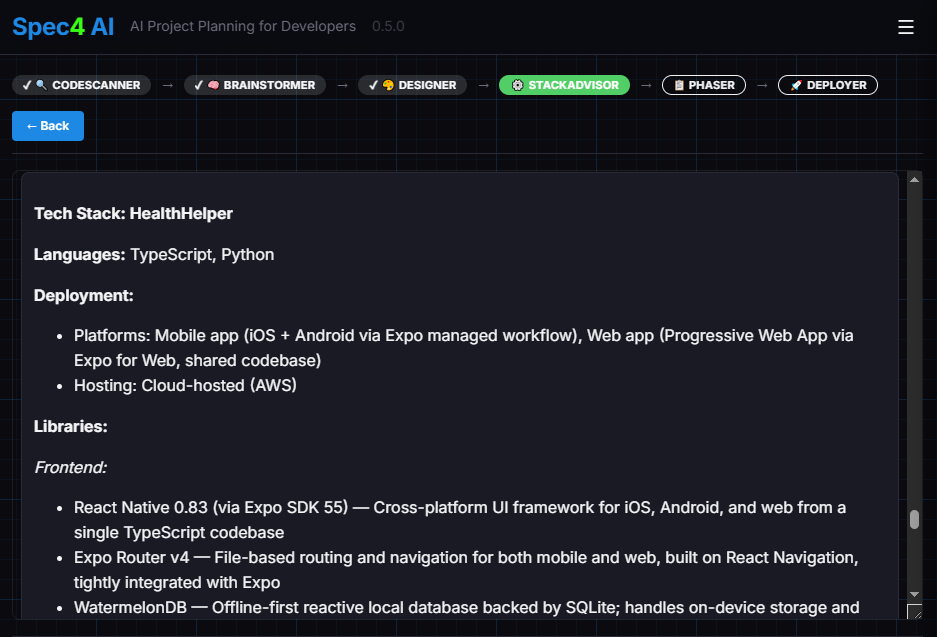
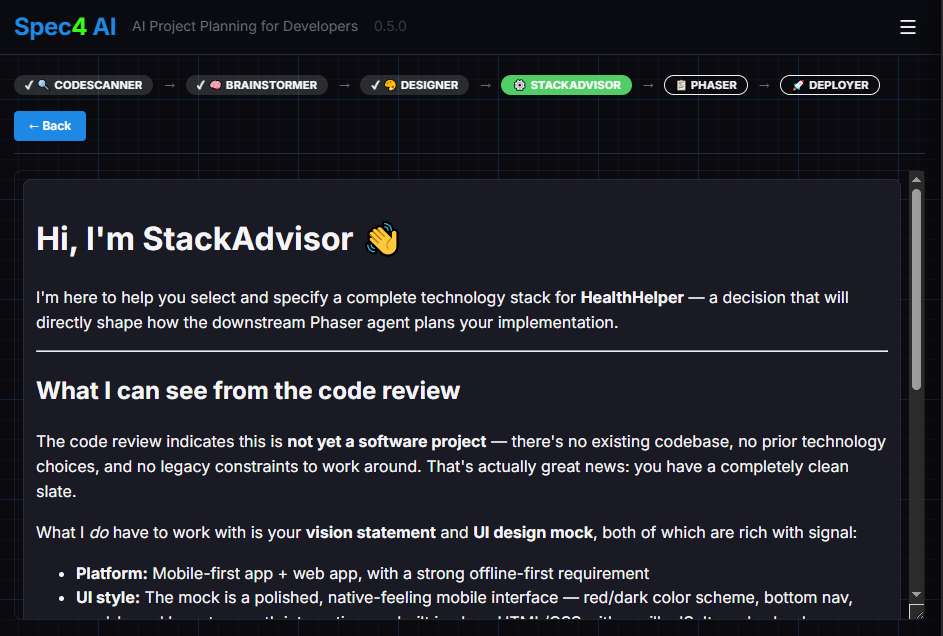
StackAdvisor start
StackAdvisor beginning technology selection
StackAdvisor end
StackAdvisor technology stack output

What StackAdvisor covers

StackAdvisor works through the technology stack in order, one decision at a time:

1.
Programming language(s)
What language fits the vision, the team, and the deployment target? Each option is assessed against the specific requirements surfaced by Brainstormer.
2.
Deployment platforms
GitHub repository, web app, iOS, Android, CLI, or a combination — mapped to the deployment targets your vision requires.
3.
Hosting approach
Self-hosted, cloud-hosted, or managed service — with the trade-offs of each explained in the context of your specific project's scale and constraints.
4.
Libraries — for every functional area
For each area the project needs (database access, authentication, HTTP, data validation, UI, AI integration, etc.), StackAdvisor identifies the best candidate libraries with maintenance status, adoption, footprint, honest strengths and weaknesses vs. alternatives, and what you'd have to write yourself without it.
5.
Coding style
Linter, formatter, indentation style, line length, quote style, naming conventions, and type-checking approach. The goal is a coding_style section that a coding agent can follow with zero ambiguity.

Conflict detection

If a code review is present, StackAdvisor actively compares its recommendations against your existing choices. When it detects a conflict, it explains the implication and offers three concrete paths:

Keep the existing technology
Maintain consistency with the current codebase. No migration effort required.
Migrate to the new choice
With an honest assessment of the migration effort and what it entails.
Hybrid approach
Use both where each makes sense, with a clear boundary between them.

Example exchange

StackAdvisor
For the backend framework, your vision calls for a Python backend. Here are the leading options for REST API development:
1. FastAPI — Modern, async-native, auto-generates OpenAPI docs. Recommended for AI-integrated applications. 70k+ GitHub stars, actively maintained.
2. Django REST Framework — Battle-tested, full-featured, excellent admin interface out of the box. Higher learning curve, heavier footprint.
3. Flask — Lightweight and flexible, but you'll write significantly more boilerplate for validation, serialization, and docs.
4. Suggest your own option
Pick one.

What the stack spec includes

The confirmed stack_spec JSON — from the healthcare app example:

{ "stack_spec": { "name": "ClinicAssist", "languages": ["Python", "TypeScript"], "deployment": { "platforms": ["Mobile app (React Native)", "REST API backend"], "hosting": "Cloud-hosted (AWS), offline-capable mobile client" }, "libraries": { "backend": [ { "name": "FastAPI", "purpose": "REST API framework" }, { "name": "SQLAlchemy", "purpose": "Database ORM" }, { "name": "Pydantic", "purpose": "Data validation" } ], "mobile": [ { "name": "React Native", "purpose": "Cross-platform mobile UI" }, { "name": "WatermelonDB", "purpose": "Offline-first local database" } ] }, "coding_style": { "linter": "Ruff", "formatter": "Ruff format", "indentation": "4 spaces", "naming_conventions": { "functions": "snake_case", "classes": "PascalCase" } }, "references": [ { "standard": "HL7 FHIR R4", "url": "https://hl7.org/fhir/R4/" } ] } }

Ready to choose your stack?

Open Spec4 and let StackAdvisor guide you through every technology decision — one choice at a time.